 Illustration
The growing cost of growing old in Northern New York
Fuel, food, property taxes, prescriptions and a home-care system that can't always show up. What it now takes for an older North Country resident to stay in their own home, and what's at stake for the region's paid-off houses.
In a lot of North Country kitchens, the question sounds simple: can Mom stay at home?
The answer depends on things a family can't control. Is there an aide who can make the drive out a rural road in February? What will Medicare actually cover? Can a son or daughter leave work? Is there a nursing-home bed, and staff to care for a new resident? And underneath all of it: can a fixed income keep up with the fuel bill, the grocery bill and the tax bill on a house that was paid off years ago?
ClickNNY spent this week going through the public record: state health data, county health surveys, federal price data, hospital bankruptcy filings and the paperwork behind New York's home-care overhaul. What it shows is a region getting older, care that is harder to reach, and costs rising faster in some of the places seniors can least avoid them.
It's also a story with deadlines. Medicare open enrollment runs through Dec. 7, Election Day is Tuesday, Nov. 3, and the paperwork that protects a senior's home from the full tax bill is due by March 1 in most towns.
Three counties, three different age pictures
State Health Department profiles for 2024 put residents 65 and older at 16.2% of Jefferson County, 21.8% of Lewis County and 19.8% of St. Lawrence County, against 18.9% statewide.
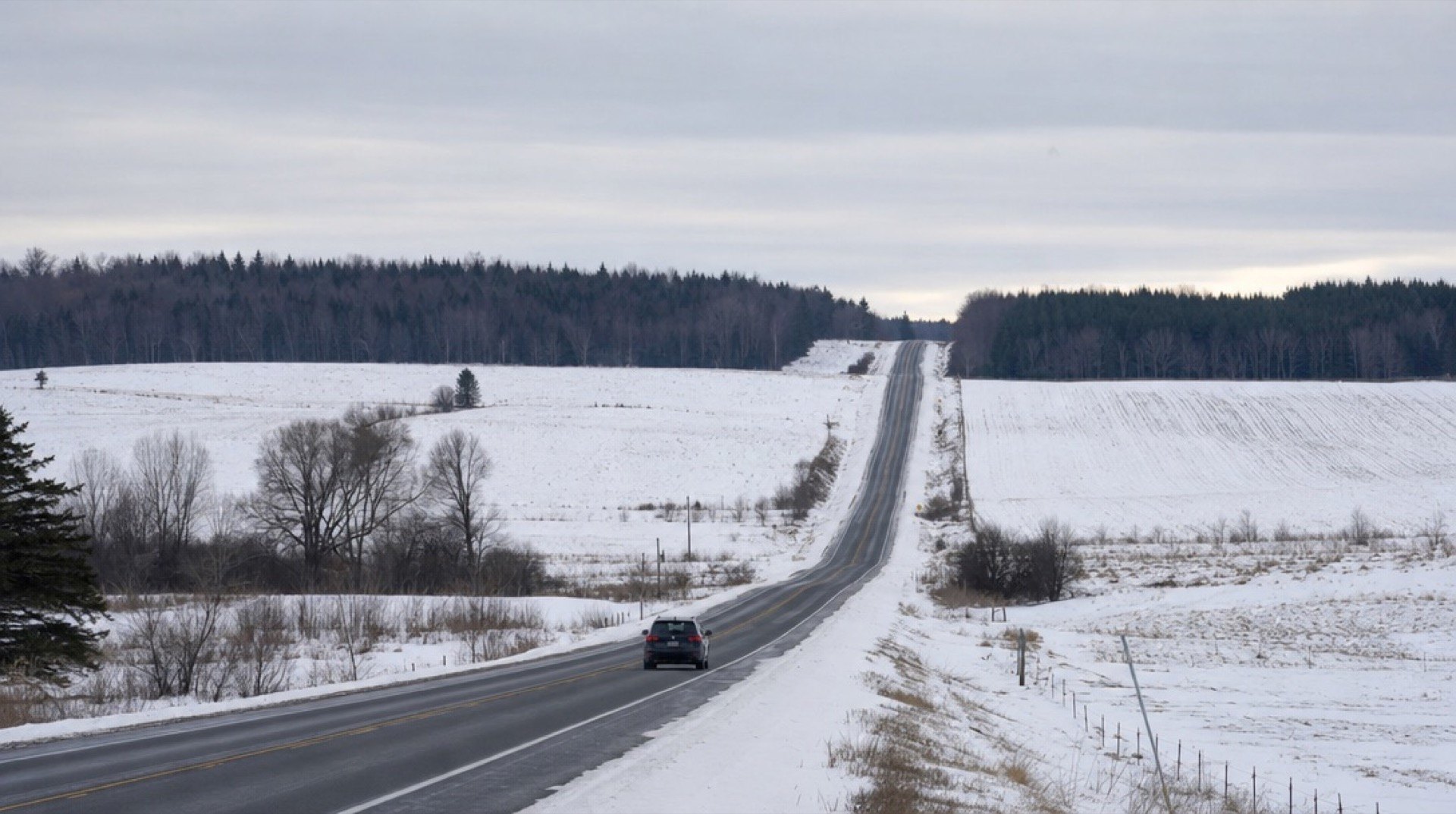
Lewis County stands out. Jefferson's lower number comes partly from Fort Drum, whose soldiers and families pull the county's average age down. The countywide figure hides a lot: a retiree in a Watertown apartment near Samaritan and a widow at the end of a seasonal road in Pinckney may share an insurance card, but not the same access to care.
 Illustration
The price tag
Start with what care costs when a family has to buy it. CareScout, the long-term-care research firm that runs the industry's largest annual price survey, put New York's 2025 median at $80,080 a year for a non-medical home caregiver, $82,140 for assisted living and $186,333 for a shared nursing-home room, about 62% above the national median of $114,975. Assisted living rose 9% in a year; a shared nursing-home room rose 5%.
CareScout also prices the North Country. In the Watertown metro area, the 2025 medians were $88,836 a year for assisted living, $155,125 for a shared nursing-home room and $170,090 for a private room. In the state's rural, non-metro areas, which take in places like Ogdensburg, a home caregiver working 44 hours a week cost a median $114,400 a year, higher than the statewide median, a sign of how hard it is to staff rural routes.
Those are benchmarks, not anyone's bill. Insurance, Medicaid and the hours a person actually needs change the math. But they explain why so many families never call an agency at all.
The home-health visit that doesn't come
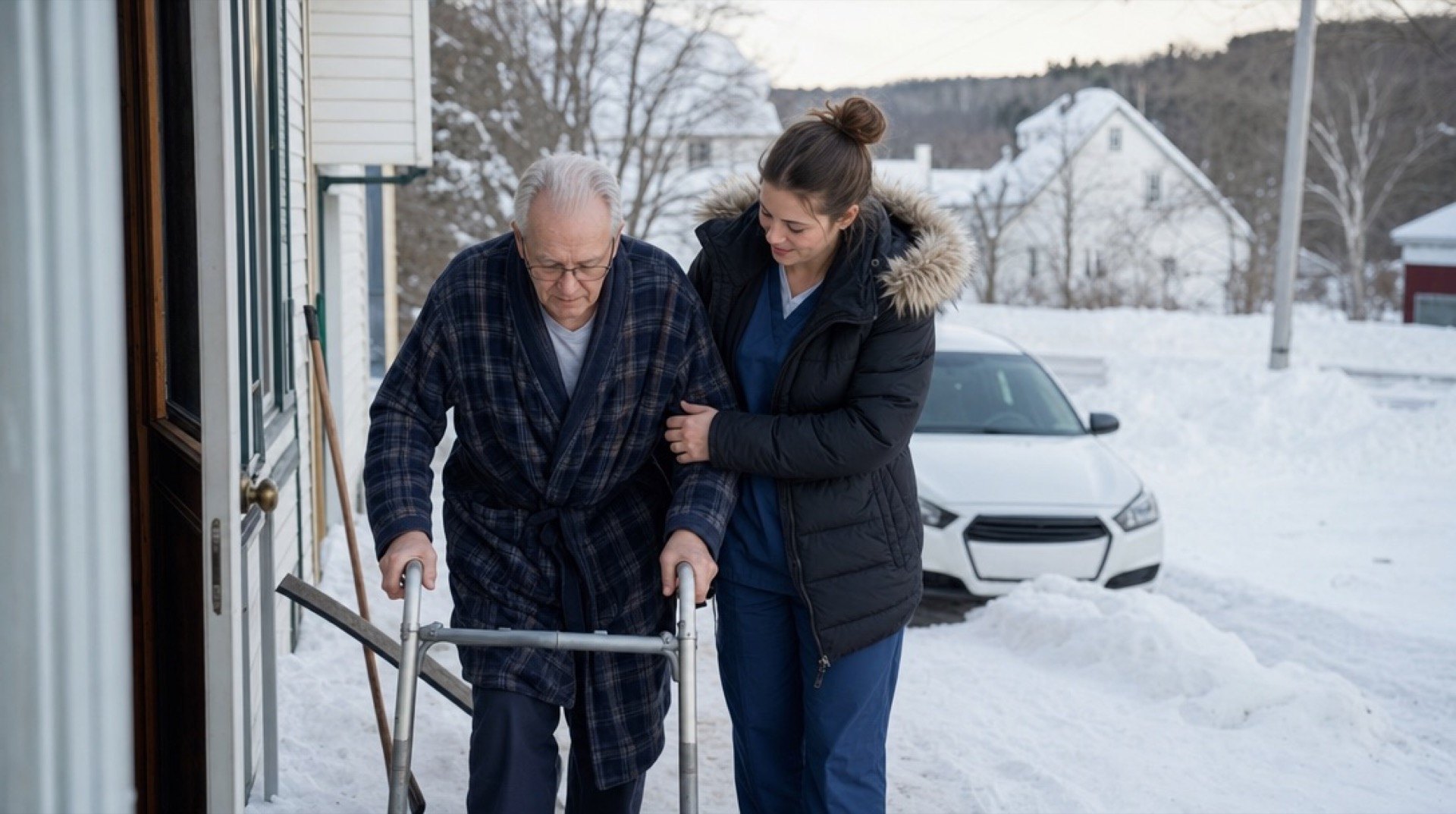
When a hospital sends an older patient home with orders for visiting nurses or therapy, Medicare usually pays. The question is whether anyone shows up.
In a September 2025 letter to President Trump and federal health officials, 24 members of New York's congressional delegation, led by Rep. Ritchie Torres, cited National Alliance for Care at Home data showing Medicare home-health use fell 39.9% in the North Country between 2018 and 2024, compared with 25.9% statewide. The letter also said 40% of New York patients referred to home health after a hospital stay did not receive it in 2024, and that the state has lost 29 home-health agencies since 2018. The North Country's own representative, Rep. Elise Stefanik, was not among the signers.
Two cautions. The letter doesn't say which counties it counts as the North Country, and the 40% figure is statewide. And a drop in use isn't the same as a count of people turned away: some patients may have recovered with family help or moved to other care. What ClickNNY is asking the region's home-health agencies is the number that matters: how many referrals they had to turn down this year, and how long patients waited for a first visit.
 Illustration
The invisible workforce: family
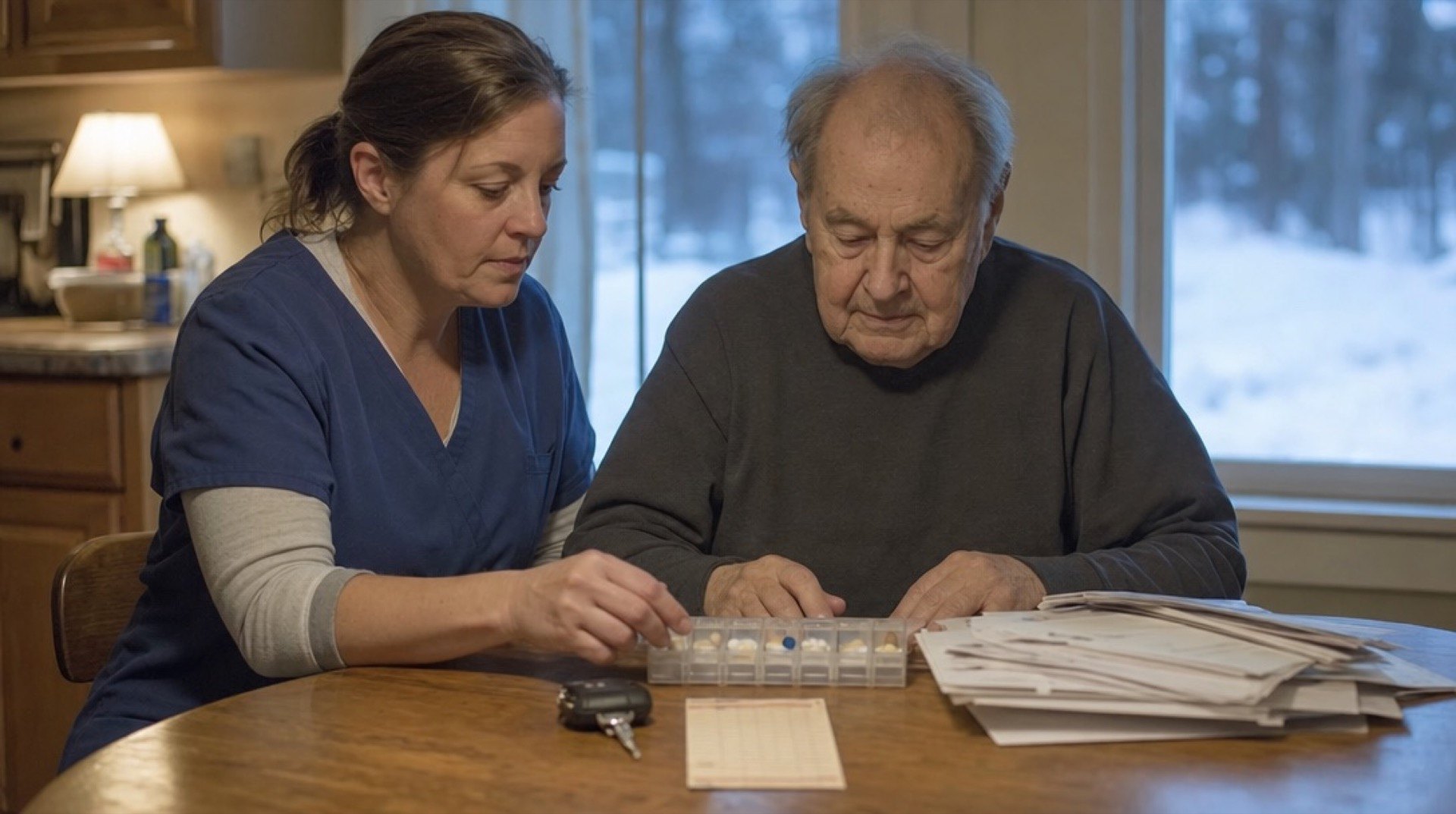
When care can't be found or paid for, family fills in. The Fort Drum Regional Health Planning Organization's 2025 community survey of 1,497 adults in Jefferson, Lewis and St. Lawrence counties found 27% give some unpaid care to a relative or friend. 11.4% of Jefferson respondents, 12.3% in Lewis and 11.7% in St. Lawrence said they give 10 or more hours a week, close to a part-time job.
Roughly three in four respondents across the region named at least one difficulty they face or expect as caregivers. Stress led the list at 48%, followed by finding the time (41%) and balancing a paid job (35%). In Jefferson County, 37% named work, the highest of the three counties.
Nationally, AARP's October 2026 study found family caregivers now spend an average of $11,508 a year of their own money on rides, supplies, medications and home changes, almost 60% more than in 2021.
 Illustration
Hospitals under strain
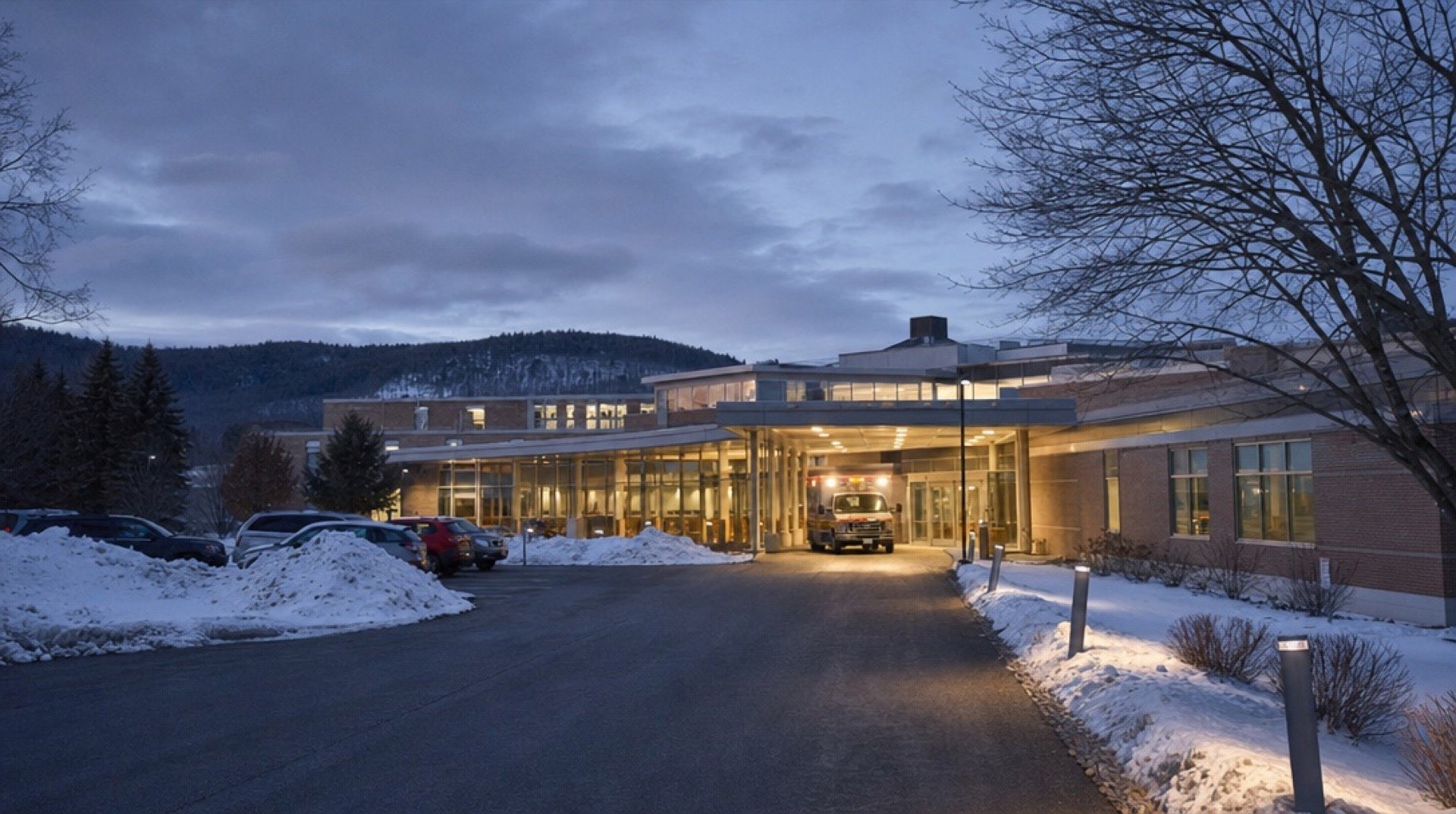
The New York State Nurses Association reported in March that the seven-county North Country (Clinton, Essex, Franklin, Hamilton, Jefferson, Lewis and St. Lawrence) lost 226 hospital beds between 2013 and 2024, including nearly half of its pediatric beds. More than half the region's hospitals became Critical Access Hospitals in that time, a federal status that caps them at 25 acute-care beds. The union is in contract talks at several North Country hospitals, and its numbers should be read with that in mind.
Closer to home, **North Star Health Alliance**, the parent of Carthage Area Hospital and Claxton-Hepburn Medical Center in Ogdensburg, filed for Chapter 11 bankruptcy on Feb. 10. The state Health Department said both hospitals would stay open. In May, a court-appointed monitor reported that patients at North Star facilities were getting quality care, a report the bankruptcy judge called "very positive."
In July, North Star proposed closing a set of services: the sleep center in Carthage, primary care and physical therapy at the Philadelphia Health Center, labor and delivery and nuclear medicine at Claxton-Hepburn, primary care at its Madrid, Waddington, Hammond and Heuvelton health centers, and an orthopedic surgery center in Watertown. Each closure needs state Health Department approval. As of this week, ClickNNY found no public record that the state has approved any of them, and the Claxton maternity decision has been pushed to Dec. 17 at the earliest. At an Oct. 23 hearing, North Star's lawyers warned the court that the system's survival depends on cutting costs and losses.
For older patients, a closed clinic in Hammond or Heuvelton isn't about a building. It's a longer drive for a blood-pressure check.
 Illustration
Who pays for what
Much of the confusion, and a lot of the fear, comes from mixing up programs. Medicare covers hospital stays, doctors and short stretches of skilled nursing or home health after an illness. It does not pay for years of help with bathing, dressing and meals. That kind of long-term care is paid by Medicaid for those who qualify, by private long-term-care insurance, or by the family.
One Medicaid program lets eligible New Yorkers hire their own aide, including a relative: the Consumer Directed Personal Assistance Program (CDPAP). In April 2025 the state replaced hundreds of local agencies that handled payroll with one statewide company, Public Partnerships LLC (PPL), and in September 2025 it tightened the rules for new enrollees.
In June, the U.S. Justice Department sued the state Health Department, its Medicaid director and PPL in federal court in Brooklyn, alleging a "sham bid process" in the contract award. The state called it a baseless, politically driven complaint. PPL said it "strongly disagree[s] with the characterizations" and was chosen in a competitive process. Nothing has been proven in court. ClickNNY is asking the Health Department how many people in Jefferson, Lewis and St. Lawrence counties use CDPAP now, compared with before the switch.
A fixed income meets this winter's bills
On Oct. 14, Social Security announced a 3.6% raise for 2027, about $75 a month for the average retired worker, starting with January checks. On the same day, the Bureau of Labor Statistics reported prices up 3.7% nationally over the past year and 4.2% in the Northeast. The raise is already behind before it arrives.
And the average hides where the pain is. Groceries have actually been one of the calmer parts of the budget: food at home is up 1.6% in the Northeast. Energy is not. Energy prices in the Northeast are up 23.1% in a year, gasoline 35.8%, and nationally, fuel oil is up 74.2%.
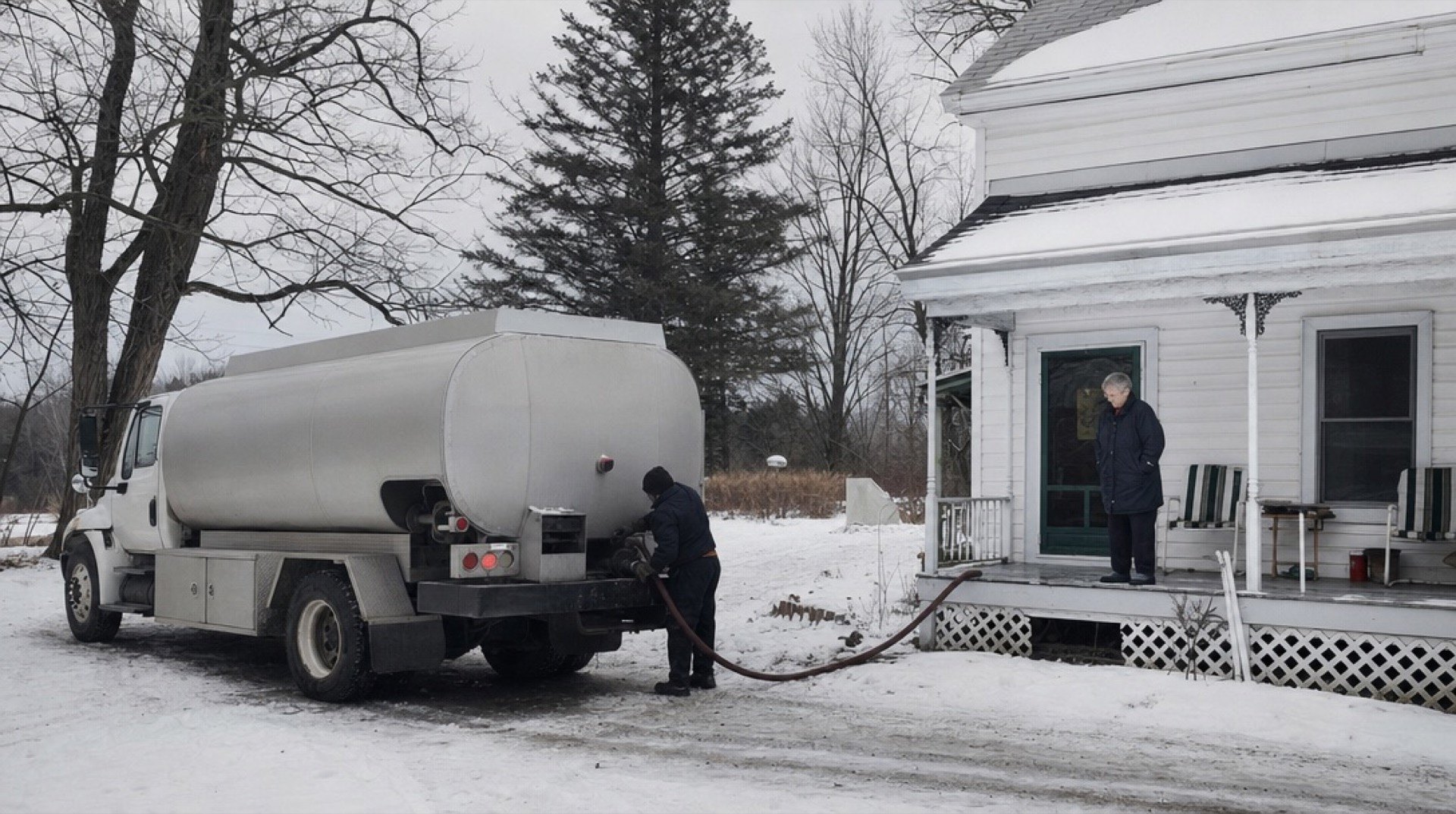
That last number lands hardest here. According to Census data, 30% of Lewis County homes and 24% of St. Lawrence County homes heat with oil or kerosene, compared with 16% statewide. Another 16% to 22% use propane, and nearly one in five Lewis County homes burns wood.
 Illustration
Do the math on a modest winter. A North Country home that burns 500 gallons of heating oil will pay about $1,275 more than last year at today's NYSERDA price. The average Social Security raise adds about $900 over a full year. Propane has risen less, about 15%, and the federal Energy Information Administration expects a milder Northeast winter, which would help. But for an oil-heated house on a fixed income, this winter's raise is spoken for by the first delivery or two.
Then there's the driving. Rural seniors don't have the option of skipping the car. A trip from Harrisville or Croghan to a specialist in Watertown, or from Hammond to Ogdensburg, is a tank of gas that costs about 41% more than it did last October. In Watertown, CitiBus offers half fares for riders 65 and older or with a Medicare card. Elsewhere, county transit routes are limited, and Medicaid riders can book free rides to medical appointments through Medical Answering Services.
Medicare itself is getting more expensive. The standard Part B premium, which comes straight out of Social Security checks, jumped to $202.90 a month this year from $185. The 2027 figure hasn't been announced; the Medicare trustees' projection is about $209.50.
 Illustration
Can a senior lose a paid-off house to taxes?
It's the question behind a lot of kitchen-table worry: if home values keep climbing and the tax bill climbs with them, can an older person on a fixed income lose a house they paid off years ago?
The North Country has a lot riding on the answer. Census data shows 43% of Jefferson County homeowners, 49% in Lewis and 52% in St. Lawrence own their homes with no mortgage, more than the state as a whole. For many retirees, the house is the savings account.
Values have climbed fast. Zillow's home value index puts the typical home at $234,099 in Jefferson County, $198,555 in Lewis and $149,753 in St. Lawrence, each up about 30% in five years.
Here's what that does and doesn't mean. A rising value doesn't by itself raise a tax bill. Taxes are set by how much money each county, town, city, village and school district decides to raise, its levy, and that levy is then spread across everyone's property. When values rise, the rate per $1,000 usually falls. What raises a bill is a growing levy, or a reassessment that moves more of the load onto your house than your neighbor's.
Both are happening. Jefferson County's 2027 tentative budget lowers the county rate for the sixth straight year, to $5.56 per $1,000 of full value, but the total levy rises 6.3%, to $70.5 million. The budget's own tax-cap table shows a $2.7 million limit; the proposed increase is $4.19 million. County officials blame state mandates and new SNAP costs shifted to counties by Congress, and warn the 2028 rate could rise more than 10%. Because of equalization, county taxes on a $100,000 home would rise about $83 in the Town of Watertown and about $112 in Theresa and Worth. St. Lawrence County's tentative budget also trims its rate, to $6.87, while the levy rises 7.2%.
Reassessments can be a shock. When the Town of Canton did its first full revaluation since 2008 this year, many home values doubled. The supervisor told residents that didn't mean their taxes would double, and many who grieved their new assessments won reductions. But a reassessment does shift taxes toward the homes whose values rose most.
 Illustration
So do seniors lose homes over it? Tax foreclosure happens in the North Country, but it is slow and it is not common. Jefferson County's June auction started with 66 properties that were three years behind on taxes; owners paid up on several before the sale, leaving 57. St. Lawrence County's September auction listed about 55. Neither county reports how many were owner-occupied homes, or how many belonged to seniors. ClickNNY is asking.
There are protections, and too few people use them:
Time. Under state law, a county can't take a property until at least two years after the tax lien, and counties can extend that to three or four years for homes and farms.
Payment plans. Jefferson County's delinquent tax program lets owners outside the City of Watertown enter an installment agreement with 25% down; the county holds off on foreclosure as long as payments and new taxes stay current. Call the county treasurer at 315-785-3055.
Your equity. After the U.S. Supreme Court's 2023 ruling in *Tyler v. Hennepin County*, New York changed its law in 2024. If a county sells a foreclosed home, any money above the taxes, interest and fees owed belongs to the former owner, who has at least three years to claim it. Counties can no longer keep a senior's equity.
Exemptions. This is the big one. The Senior Citizens' Exemption can cut a home's taxable assessment by up to 50% for owners 65 and older whose income falls under the limit their town, city, county or school district has set, up to $50,000 under the state rule, with smaller exemptions on a sliding scale above that. Enhanced STAR is worth up to $605 this year in the Watertown City School District, $473 in Carthage, $467 in Lowville, $1,173 in Massena and $1,642 in Ogdensburg, for homeowners 65 and older with incomes up to $110,750. The application for most exemptions is due to your local assessor by March 1.
The honest answer: losing a paid-off home to taxes is rare, but the squeeze is real. The bigger risk for most North Country seniors isn't the auction. It's that the tax bill, the fuel bill and the cost of care all grow faster than the check, until the only way to pay is to sell.
What the election can and can't change
Candidates on Tuesday's ballot will promise to protect Medicare, Social Security and rural hospitals. Voters should ask which level of government actually controls each one. Medicare and Social Security are federal. Medicaid rules, CDPAP and hospital closure approvals run through Albany. Property-tax exemptions are set by state law but adopted, or not, by each county, city, town and school district.
ClickNNY will send the same questions to the candidates in our congressional and state legislative races, and we'll publish their answers in full.
What we're still asking
Public data only goes so far. ClickNNY is reaching out to North Star Health Alliance, Samaritan Health, Lewis County Health System, the state Health Department, PPL and the three county Offices for the Aging for local numbers: home-care waitlists, referrals turned down, days from hospital discharge to a first home visit, and CDPAP enrollment. We'll update this story with their answers.
And we want to hear from you. If you're an older North Country resident trying to stay home, a family member doing the caregiving, or an aide driving those routes, tell us your story. We won't publish your name or health details without your permission.
Where North Country seniors can call
Each county's Office for the Aging can help with Medicare counseling, NY Connects, home-care referrals and caregiver support. Numbers are from official county and state pages.
County Offices for the Aging
- Jefferson County Office for the AgingDirector Bethany Munn · 175 Arsenal St., 2nd Floor, WatertownWeekdays 8:30 a.m. to 5 p.m. Medicare counseling, NY Connects, caregiver supportOffice: 315-785-3191
- Lewis County Office for the Aging5274 Outer Stowe St., LowvilleWeekdays 8:30 a.m. to 4:30 p.m.Office: 315-376-5313
- St. Lawrence County Office for the Aging80 State Highway 310, Suite 7, CantonAlso the county's NY Connects lineOffice: 315-386-4730
Statewide and federal
- NY ConnectsLong-term care options and referralsToll-free: 1-800-342-9871
- HIICAP Medicare counselingFree, unbiased help comparing Medicare plansHelpline: 1-800-701-0501
- 1-800-MEDICARE24/7: 1-800-633-4227
- CDPAP / Public PartnershipsConsumer-directed home care payrollPPL: 1-833-247-5346
What worries you most about growing older in the North Country?
0 votes · tap to vote
Questions readers are asking
- Will rising home values make my property taxes go up?
- Not by themselves. Your bill depends on how much your county, town, city, village and school district raise in total (the levy) and on your share of the area's total value. When values rise, the tax rate usually falls. Bills go up when the levy grows or when a reassessment shifts more of the load to your home. Jefferson and St. Lawrence counties are both lowering their 2027 rates while raising their total levies.
- Can I lose my paid-off house if I fall behind on property taxes?
- It can happen, but it takes years and there are protections. New York counties generally can't foreclose until at least two years after a tax lien. Many offer payment plans. Since 2024, if a county sells your home, any money above what was owed must go back to you. And senior exemptions can cut the bill sharply. If you are behind, call your county treasurer early.
- How much is the Senior Citizens' Exemption?
- Up to 50% off a home's taxable assessment for owners 65 and older, if income is under the limit set by the local town, city, county or school district (up to $50,000 under the state rule), with smaller exemptions on a sliding scale above that. Limits differ from place to place, so ask your local assessor. Applications are generally due by March 1.
- Does Medicare pay for a home health aide?
- Only in limited cases. Medicare covers part-time skilled nursing or therapy at home after an illness or injury when a doctor orders it and you are homebound. It does not pay for long-term help with bathing, dressing or meals. Medicaid, including New York's CDPAP program, can pay for that for people who qualify.
- Is Social Security's 3.6% raise enough to keep up?
- For many North Country households, not this winter. Northeast prices rose 4.2% in the year to September, and North Country heating oil is up about 75%. The average retired worker's raise is about $75 a month, while a 500-gallon oil winter costs about $1,275 more than last year.
- Where can I get help paying for heat?
- New York's Home Energy Assistance Program opens Nov. 2, 2026. Oil and propane households can get $990, with extra for homes with someone 60 or older. Apply at mybenefits.ny.gov, through your county Department of Social Services, or ask your Office for the Aging for help with the application.
More from ClickNNY

ClickNNY Special Report · Preparedness
Is the end of the world coming? What it means for the North Country

ClickNNY Election 2026 · Showdown in Jefferson County
Ousted by his own party, still on the ballot: inside Jefferson County’s three-way fight for power
ClickNNY Guide · Community
Protecting hibernating bats in St. Lawrence County: what to know
Tell us what we missed
Know something North Country readers should hear about this? Send the ClickNNY desk a local tip, a correction or a photo.
Editor’s note: This report is built from public records ClickNNY checked this week: state Health Department county profiles, federal price data from the Bureau of Labor Statistics, NYSERDA fuel prices, AAA gas prices, Census housing data, county budgets, the CareScout cost-of-care survey, the 2025 North Country community health assessments, bankruptcy-court coverage and the federal lawsuit over New York's home-care program. Where a number covers the whole state, the nation or a wider North Country region, we say so. ClickNNY is reaching out to North Star Health Alliance, Samaritan Health, Lewis County Health System, the state Health Department, Public Partnerships LLC and the three county Offices for the Aging, and will add their answers. Images marked as illustrations were made for this story and do not show real people or places.