 Illustration
Sharing the Road, Risking Their Lives
Four people died in two buggy crashes in New York in less than two weeks this fall, both in broad daylight. What drivers, Amish families and the officials who run our roads each owe the next family on the road.
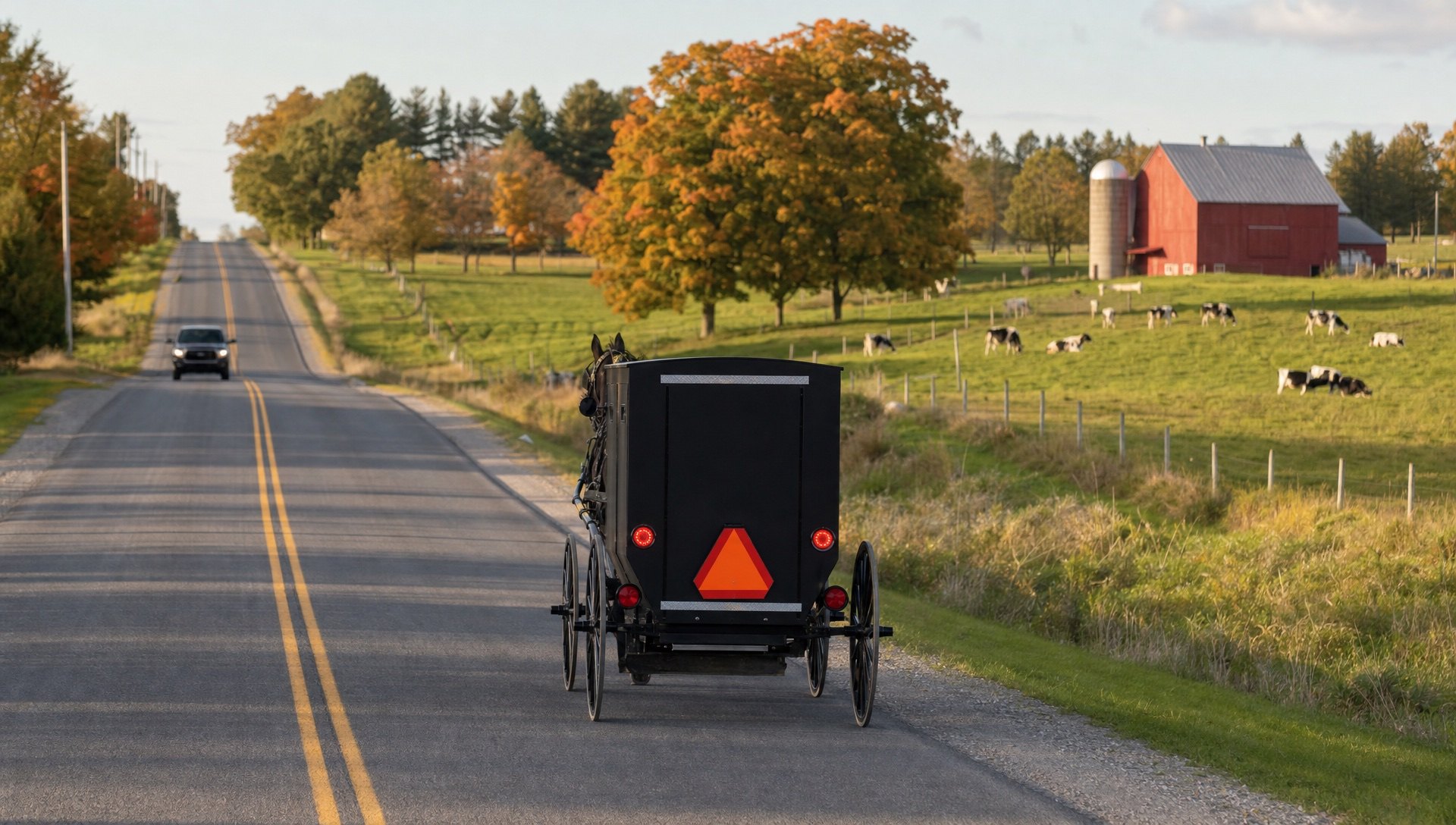
A horse moves steadily along a rural North Country road, pulling a black buggy carrying a family. In parts of St. Lawrence, Jefferson and Lewis counties it is as ordinary a sight as a dairy barn or a hayfield.
A few hundred feet behind, a pickup crests a hill. It is doing 55. The buggy is doing five. That gap in speed is more than an inconvenience. It leaves a driver only a few seconds to see what is ahead, understand it and react.
For Amish families, the horse and buggy is part of a way of life rooted in faith and community. For everyone else, the car is how we get to work, to the doctor and to the hospital. Both have a lawful place on the road. This fall, on two rural roads in New York, the two met with deadly results, and the questions those crashes raise reach well beyond any single driver.
A September that left families grieving
On Sept. 13, shortly before 3 p.m., a pickup truck struck an Amish buggy from behind on County Route 25 in the Town of Canton, near Little River Road. The buggy was carrying ten people. Margaret Wagler, 78, of Canton, and her 4-year-old grandson were killed. Eight others were injured.
About 15 ambulances and 10 fire departments responded. Richard Rusaw, St. Lawrence County's director of emergency services, said he had not personally seen an accident with that many people involved. In mid-October, a 35-year-old woman remained in critical condition and a 5-year-old girl was hospitalized in stable condition.
The Sheriff's Office has identified the driver as a 34-year-old Russell man. No charges have been filed, the cause has not been released, and the crash remains under investigation.
Twelve days later, on Sept. 25 at about 9:16 a.m., a van struck two southbound buggies on County Route 41 at Manwaring Road in the Oswego County town of Richland. The buggies carried nine children. Anna J. Hershberger, 13, and Moses J. Hershberger, 7, died at the scene. A 10-year-old boy was seriously hurt, a 9-year-old girl was in critical condition before being upgraded to stable, and four boys had minor injuries. State Police have described their findings as preliminary. No charges have been filed.
It was not the first fatal buggy crash on that road this year. On June 6, a pickup struck a buggy on the same County Route 41, killing Susan Swartzentruber, 22, of Pulaski. State Police said no charges were expected.
Four people died in two crashes in less than two weeks. Each must be judged on its own facts; a buggy on the road does not establish fault, and neither does a motorist's involvement. But the concentration of loss calls for more than another reminder to be careful.
It happens in daylight, too
Both September crashes happened in broad daylight, one mid-morning and one mid-afternoon. So did the North Country's most painful recent example.
On Sept. 20, 2023, on County Route 2 in the Jefferson County town of Alexandria, a pickup rear-ended a buggy in the afternoon. Two brothers, Ananias Slabaugh, 1, and Andy Slabaugh, 3, were killed. The Sheriff's Office cited speed and distracted driving. The driver was charged with criminally negligent homicide and pleaded guilty.
That matters because much of the public conversation about buggy safety is about reflectors and lights. Visibility counts, especially at night. But a crash at 9 a.m. or 3 p.m. on a clear day points to other things: speed, attention, hills and curves that hide what is ahead, and roads with nowhere for a buggy to go.
Not just a North Country problem
On Feb. 20, 2026, on State Road 4 in Elkhart County, Indiana, a pickup struck a horse-drawn cart carrying four children from behind. Jenna Miller, 8, and Derek Bontrager, 7, were killed. Jayden Miller, 13, and Miciah Miller, 11, were hospitalized. The pony also died. The driver, a 40-year-old New Paris man, was charged in April with six felonies, including four counts of causing death while operating while intoxicated. As of late October, the case had not reached a verdict; local reports show the trial date has been moved more than once.
About ten months earlier, on April 9, 2025, siblings Glenda Jo Yoder, 13, Darrell Yoder, 10, and Devon Yoder, 9, were killed when a car struck their buggy from behind near Bremen in Marshall County, Indiana. The county prosecutor declined to charge the 17-year-old driver.
In Lancaster County, Pennsylvania, Mary Ruth Stoltzfus, 65, died on Jan. 7, 2026, after a minivan struck her buggy on Strasburg Road. The driver was charged with homicide by vehicle while driving under the influence, and the case is headed to court.
Hard numbers are scarce, because no national system tracks buggy crashes consistently. Purdue University's 2024 Indiana farm-fatality summary counted six Amish and Old Order buggy incidents in that state alone, with 15 injuries and two deaths, and its researchers cautioned that more may have gone unreported. The victims ranged in age from 2 to 81.
A way of life worth understanding
To talk about this fairly, it helps to understand why Amish families keep the horse and buggy. For Old Order communities it is not nostalgia. Not driving cars is tied to keeping family and church close, to depending on neighbors, and to setting limits on how far and how fast life moves.
Amish church districts make their own decisions about technology, and those decisions differ. That includes what kinds of lighting, reflective material and battery-powered equipment are acceptable. What one settlement accepts, another may not. Any honest safety conversation has to start with the people who make those decisions, not with assumptions about what "the Amish" believe.
Religious freedom matters. So does protecting human life. A serious conversation can respect both without using either as a reason to avoid hard questions.
“A road can be ordinary for a driver at the posted speed and unforgiving for a buggy on the same pavement.”
Drivers: the faster vehicle carries more of the burden
Under New York Vehicle and Traffic Law Section 1105, a person driving a horse-drawn vehicle has the same rights and duties as any other driver, except where a rule simply cannot apply. A car does not earn a bigger claim to the road by going faster.
On a rural road, the shoulder may be narrow, soft or a short drop to a ditch. A buggy often has nowhere safe to go. A few seconds looking at a phone can use up most of the time a driver has to recognize a slow vehicle ahead, even at the speed limit.
Buggy drivers: tradition comes with responsibility, too
Amish families have every right to use public roads, and the same responsibilities that come with it. Their passengers, often children, have no seat belts, air bags or steel around them. That makes visibility, well-kept equipment and predictable driving especially important.
Where lights and markings are required by law, they are not optional. Where more is allowed but not required, there are good reasons for communities to look again. And there are practical questions worth asking openly: how young drivers are trained for roads with modern traffic, and whether certain routes are simply too dangerous at certain times.
The road is the third party in every crash
Drivers and buggy operators both have duties. But the road itself is designed, maintained and regulated by government, and on County Route 25, residents have made clear they think it is part of the problem.
At a St. Lawrence County board meeting in early October, neighbors described a steep drop from the pavement to the gravel shoulder, cars speeding, including near a school, a hilly road with curves and blind corners, and buggy traffic that keeps growing. Since then, neighbors say gravel has been added along parts of the road. Sheriff Rick Engle's office placed two speed radar signs near the crash site and says it will collect speed data and share it on request.
Those are steps. The questions are what comes next. Will the speed data lead to enforcement or engineering changes? Are the shoulders wide and firm enough for a buggy to use? Would better sight lines or passing zones help? And how many other North Country roads look just like this one?
A warning sign helps drivers expect a buggy. It does not widen a shoulder, fill a ditch or straighten a blind curve.
The pavement question
There is a quieter side to this. Two Ohio University studies for the Ohio Department of Transportation, in 2017 and 2020, found that on heavily traveled buggy routes, pavement repair costs ran about four times higher than on other roads. The main cause was the hard steel cleats welded onto horseshoes for traction. The researchers also found that alternative shoes, such as low-profile or tungsten-carbide-coated designs, gave horses similar grip while putting far less stress on the road.
That is Ohio, not here. Heavy trucks, plows and freeze-thaw cycles all chew up North Country roads, and no local study has measured what buggy traffic adds. Amish families also pay property, sales and other taxes that fund those roads. The fair question for county highway departments is simple: have you seen this damage here, and has anyone talked about alternatives?
We have talked about this before
Buggy safety is not a new concern in St. Lawrence County. In July 2015, then-state Sen. Patty Ritchie, Sheriff Kevin Wells, county legislators, State Police and bishops of the Heuvelton settlement reached a voluntary agreement on reflective markings. Buggies would carry 144 square inches of reflective tape, about double the state minimum of 72 square inches on the rear.
It showed cooperation was possible without anyone giving up their principles. But a later meeting on new buggy markings was cancelled, and the county legislature did not act on a buggy resolution. More than eleven years on, it is fair to ask: Was the agreement widely followed? Is it still? Has anyone measured whether it worked? And have growing settlements and heavier traffic created needs it never covered?
A lighting bill still sitting in Albany
Senate Bill S7628, sponsored by Sen. Jeremy Cooney, would set lighting rules for horse-drawn vehicles traveling at night: two front lamps visible at 350 feet, a red or amber rear lamp visible at 500 feet, and reflective material on the shafts. The Assembly version is A6321. The bill's memo notes New York's Amish population grew from about 12,000 in 2010 to about 23,000 in 2023, and it cites the 2023 Alexandria crash.
As of Oct. 27, 2026, the bill is still in the Senate Transportation Committee. It may be worth passing. But the Alexandria crash happened in daylight, and so did both crashes this September. Better lights help at night. They do not fix distraction, speed, blind hills or missing shoulders.
The cost beyond the families
A crash like Canton's ripples outward. Volunteer firefighters, EMTs, dispatchers and deputies may know the families they are helping. Large calls pull crews from neighboring towns and thin out coverage elsewhere. Recovery stretches over months of treatment, lost work and grief.
The drivers involved carry it too, whether or not charges ever come. Responsibility should be settled by evidence, not assumptions, while recognizing that every one of these crashes changes many lives at once.
Two ways of life, one road
There is something good about a place where a buggy and a pickup share the same road past the same farms. It is a reminder that neighbors can live very differently and still be neighbors.
But respect does not change physics. A buggy at five miles an hour and a truck at 55 do not become compatible because both have a right to be there. Drivers have to slow down and pay attention. Buggy operators have to be as visible and predictable as their faith allows. Lawmakers have to take on hard questions. And road agencies have to accept that a road carrying buggies may need to be built differently than one that doesn't.
For the families in Canton, Richland, Alexandria, Indiana and Pennsylvania, none of this is theoretical, and nothing will bring back who they lost. What their losses can do is push the rest of us to act before the next family is on the road. The next buggy is already out there. So is the next driver.
We asked for answers
On Oct. 27, ClickNNY asked North Country state lawmakers, the sponsors of the buggy-lighting bill, the leaders of the Legislature's transportation committees, and county leaders in Jefferson and Oswego counties where they stand. We asked whether they support S7628/A6321, what they would do beyond lighting, and whether the most dangerous buggy routes should be reviewed.
We will publish their answers in a follow-up story, and we will note anyone who declines to comment. If you want to ask them yourself, their public office contacts are below. You can also send ClickNNY a tip or comment.
What would do the most to make North Country roads safer for buggies?
0 votes · tap to vote
Common questions
- Do horse-drawn buggies have the right to use New York roads?
- Yes. Under New York Vehicle and Traffic Law Section 1105, people driving animal-drawn vehicles have the same rights and duties as other drivers, except for rules that by their nature cannot apply.
- How fast does a car close on a buggy?
- At 55 mph behind a buggy doing 5 mph, the closing speed is 50 mph, or about 73 feet per second. A 500-foot gap disappears in roughly 6.8 seconds, and Penn State Extension notes a car at 55 mph needs about 400 feet to stop.
- What happened in the Canton buggy crash?
- On Sept. 13, 2026, a pickup struck an Amish buggy carrying ten people from behind on County Route 25 in the Town of Canton. Margaret Wagler, 78, and her 4-year-old grandson were killed and eight others were injured. No charges had been filed as of late October, and the crash remains under investigation.
- What happened in the Richland buggy crash?
- On Sept. 25, 2026, a van struck two Amish buggies carrying nine children on County Route 41 in the Oswego County town of Richland. Anna Hershberger, 13, and Moses Hershberger, 7, were killed. State Police described their findings as preliminary, and no charges had been filed as of late October.
- Does New York require lights on Amish buggies?
- New York requires slow-moving vehicles to carry certain markings. Senate Bill S7628 would add specific night-lighting rules for horse-drawn vehicles, but as of Oct. 27, 2026 it was still in the Senate Transportation Committee. In St. Lawrence County, a 2015 voluntary agreement with Heuvelton-settlement bishops called for 144 square inches of reflective tape.
- What should I do when I come up behind a buggy?
- Slow down early, leave plenty of room, pass only where it is legal and you can see well ahead, give the horse a wide berth, and never use the horn or rev the engine near a horse.
More from ClickNNY

Tell us what we missed
Know something North Country readers should hear about this? Send the ClickNNY desk a local tip, a correction or a photo.
Editor’s note: Fact-checked Oct. 27, 2026 (see clicknny/new stories/... fact checked.md). Before publishing: 1) confirm the Elkhart County (Hoover) trial status; 2) seek comment from Amish community representatives and from St. Lawrence County highway / Sheriff on CR 25 speed data; 3) replace the illustrative hero with a licensed or ClickNNY photo if one becomes available. Uncharged drivers are deliberately not named. Removed from the draft: the unsupported claim that the NYS Strategic Highway Safety Plan names Amish in the Watertown region.